FIRST Schedule

***FIRST has merged with FIRST Wild Card Tours***

Monday, February 26, 2007

Scimitar's Edge by Marvin Olasky

It is March 1st, time for the FIRST Day Blog Tour! (Join our alliance! Click the button!) The FIRST day of every month we will feature an author and his/her latest book's FIRST chapter!


This month's feature author is:


Marvin Olasky

and his book:

Scimitar's Edge

ABOUT THE AUTHOR:

Dr. Olasky is editor-in-chief of World Magazine, a senior fellow of the Acton Institute, and a professor at the University of Texas at Austin. He and his wife Susan have been married for 30 years and have four sons. He has written 17 non-fiction books and has also started (with several others) a Christian school; he has been a crisis pregnancy center chairman, a foster parent, a Little League assistant coach, a PTA president, and an informal advisor to George W. Bush. He is a graduate of Yale University and the University of Michigan.

Stepping away from his roles as professor, historian, and creator of "compassionate conservatism," Marvin Olasky, editor-in-chief of WORLD Magazine has penned an edge-of-your-seat novel that educates as well as it informs.

SCIMITAR'S EDGE is the story of four unique Americans on a journey that takes them to a world of great beauty and great danger. Olasky uses his vast knowledge of the culture to pen a tale about the War on Terror that is so realistic it might have been taken from today's headlines.

A FEW QUESTIONS WITH THE AUTHOR

1. What's the book about?


At its basic level it's about Americans who go to Turkey for a vacation -- I spent a month there two years ago -- and are kidnapped by Turkish Hezbollah; the question then is how to get away and whether to forget about the whole thing or attempt to fight back. In another sense Scimitar's Edge is about America and the war against terrorism: Now that it's almost five years since 9/11 many of us almost seem to be on vacation again, but the terrorists are not.
2. You're a journalist and professor by trade, with about 18 non-fiction books in your past. What led you to turn to fiction?


Largely fun. In one sense I was playing SIM Turkey: Drop four people into a harsh foreign environment, give them action and adventure, build a romance … I grew to like the characters and wanted to see what they would do. I also enjoyed the challenge: I've written lots of nonfiction books and know how to do that,
but this was all new.
3. Is your research for fiction different from your nonfiction research?


The trunk is common - as I traveled through Turkey I took notes on geography, food, customs, and so forth - but the branches differ. My nonfiction research emphasizes accuracy concerning what has happened; for example, every quotation
has to be exactly what a person said. In fiction, though, I'm
inventing dialogue, yet everything that happens has to be true to the characters and the situation.
4. What's been the feedback from your fans since your switchto fiction? Oh, are there fans?


Actually, I've gotten excellent reactions from many of the folks who like my nonfiction. A few worry about sexual allusions - one of the characters is a serial adulterer and two of the others, as they fall in love, encounter sexual tension. Scimitar's Edge is also an action/adventure novel so there's some shooting, and one of the main characters is a terrorist who relishes lopping off heads. So anyone who wants a sugary book should look elsewhere.
5. You also include some descriptions of what's been called "the forgotten holocaust" a century ago, and explain some Turkish history.


Turkey was the proving ground for the first sustained governmental attempt at genocide, as Turks killed over one million Armenians and sent many to concentration camps; Hitler admired that effort. But Turkey has often been a central player in world affairs, not a backwater. Nearly two millennia ago Turkey became a Christian stronghold: The seven churches John addresses in the book of Revelation, for example, were in what is now Western Turkey. Going back one millennium, what is now Turkey was the front line for a clash of Christian and Muslim cultures.
6. I know you wrote your doctoral dissertation about film and politics from the 1930s through the 1960s, a time when Westerns were one of the dominant genres, and I see certain Western-like elements in this book.


Westerns came in about seven different varieties, and one of them was called the "revenge Western," where a bad man has killed a beloved person and the hero heads out to bring him to justice. In nuanced Westerns the hero at various points asks himself whether his end justifies his means and whether it's worth giving up a lot to carry out what he planned. An internal struggle of that sort occurs in this book as well.
7. Scimitar's Edge is an unusual novel that combines action against terrorists with quotations from Walker Percy. In fact, the book ends with an allusion to one of Percy's most enduring characters, Will Barrett. Were you consciously trying to walk a knife-edge between high-brow and low-brow culture?


Not consciously; that's just where I am myself. Since evangelicals are sometimes disparaged as dumb, some press to show we're not by tossing around Latin phrases or going to opera rather than popular movies -- not that there's anything wrong with opera, as long as there's a car chase within the first five minutes. To me it comes down to enjoying the pleasures God gives us, including those from both popular culture and literary culture.
8. Are you planning a sequel?


When I talk with students about careers we discuss the importance of both internal calling and external calling - do you feel God's pleasure as you do something, and do other people think you're good at it? I feel the internal call to write more novels; I'm trying to discern the external call from readers.


AND NOW...THE FIRST CHAPTER:

Note: All present-day characters are fictional except for the media and political personalities in chapter sixteen and one character in chapter twenty-one: There really is a Metropolitan Ozmen at the Deur-ul Zaferan Monastery near the Turkish- Syrian border.

Descriptions of historical characters are factual. Suleyman Mahmudi did build Castle Hosap in southeastern Turkey in 1643.

The chess game in chapter fourteen derives from one played by Gustav Richard Neumann and Adolf Anderssen in Berlin in 1864, but then it was not a matter of life or death.

PROLOGUE

Zeliha Kuris sat in her living room in Konya, scarcely believing what she was watching on TRT1, the major government-run channel in Turkey. The second of the twin towers of New York was crumpling. She cried, thinking of the horrible way so many were dying. Then came a knock on her door.

She peered out cautiously. Ever since her last book, threats from Hezbollah terrorists had come as fast as the sewage ran after heavy rains. One fatwa against her read, “She has confused and poisoned Muslims with her Western ideas. She deserves death.”

But it was only a man, Trafik Kurban, whose ailing mother she had helped. They had met in the room at the hospital where the old woman was dying of lung cancer. Trafik’s hollow cheeks and chain-smoking habits made generational continuity likely, but he had seemed friendly enough as he joked about his favorite American film, The Wizard of Oz. Zeliha opened the door to him.

“I have a present for you in my car,” he said, taking her hand in his own—it was sticky soft—and pointing to a white Mitsubishi that sat at the curb. “You showed yourself a true daughter of Turkey during my mother’s duress, and I want to thank you.”

Zeliha looked up and down the street but saw no danger signs. She smiled and followed him to the vehicle. Trafik reached in, pulled out a three-foot-tall scarecrow stuffed with straw, and handed it to her. She gave it a puzzled look before smiling and saying, “It’s lovely.”

Then Trafik stuck a needle into her arm and shoved her into the car.

She came to in a dank basement. At first all she could sense was the overpowering smell of onions. The odor hung in the air and left her struggling for breath. Her hands were bound behind her back, her legs tethered to a pillar. All was quiet, but then she heard movement and conversation on the floor above.

She strained to catch what was being said. A man with a booming voice. He sounded joyous. “Passed the initiation . . . Trafik, one of us . . . member of Hezbollah.”

Hezbollah! So Trafik was not just a petty criminal. Hezbollah! Instantly she knew what would happen though her tormentors made her wait. She lost track of the time and must have dozed because when she awoke her throat was parched and a glass of water sat just beyond her reach.

She often heard the man with the loud, harsh voice talking and then laughing outside the door. When the door opened, the smell of fresh bread wafted into the room. Only when her mouth was as dry as Saudi sand and her stomach cramped from hunger did the loud man enter. Even then he was patient, standing for a time just staring at her.

Finally he leaned close, smelling of garlic, his thick black mustache tickling her check. Spit from his mouth sprayed her face. “You wanted to be Turkey’s Salman Rushdie or Taslima Nasrin, eh? They deserve to die, and you will.”

On the first day he beat her. On the second day he dripped burning nylon on her, all the time complaining that he had to use primitive torture devices because her Western allies kept him from getting modern electroshock devices. He demanded information about the members of her conspiracy. She explained that there was no conspiracy, that she had only written what was true. He became furious.

Upstairs she could hear The Wizard of Oz playing nonstop, with the Munchkins’ song turned up loud to cover up her screams. She imagined Trafik was watching, and her one hope was that he would come to see her so she could ask him how he felt betraying the woman who had been his dying mother’s only friend. Trafik did not descend, but she heard him chortle as the Wicked Witch screamed, “I’m melting, melting.”

Finally he did stand in front of her, but instead of displaying remorse he held a camera. As the loud man did his work, Trafik silently recorded the ravages of torture. Summoning her remaining strength, Zeliha spat at him. “How could you do this?” But before he answered, if he answered, she lost consciousness and never returned to life.

PART ONE
INNOCENTS ABROAD

CHAPTER ONE

Providence Community Church in South Philadelphia was hosting its end-of-the-school-year rally. Five hundred members of church youth groups from the Philadelphia and Wilmington areas came to hear a hot rock band and enjoy a cookout, with a skit about the danger of growing gang violence sandwiched in between.

The band was hammering at high decibels in the low-lit sanctuary. Teens stood on the pews, swaying and clapping to the music. No one noticed a young man entering through the double doors at the back. A white and blue bandanna covered his head and an obscenity-laden T-shirt hung nearly to his knees, still not far enough to reach the crotch of his baggy blue jeans. His right arm was tattooed with spiderwebs, “laugh now, cry later” clown faces, and the name “Luis.” His right hand held a .38. Before a greeter could offer a welcome, Luis sent a bullet through one guitar and another clanging into a microphone stand.

As the band members froze in confusion, teens in the audience laughed and applauded the clever opening to the skit. A third bullet tore into the bass drum and sent the band members scurrying.

A lone voice yelled, “He’s shooting at us! Duck down!” The skinny youth pastor, looking not much older than the kids who packed the dark sanctuary, stood up and waved his arms wildly. “This is not the gang skit. This is for real.” His voice cracked, sending the crowd into fits of laughter. Suddenly his left arm jerked wildly and a red stain spread over the sleeve of his white shirt. “Get down in the pews!” he screamed.

Kids close to him began to yell and duck under their pews. Those on the other side still thought they were part of an interactive skit. “Paintball!” one boy yelled. ”Awesome!”

Luis was outraged. “Shut up! All of you just shut up! Enough of this Jesus crap!”

One girl whispered, “Can he say that in church?” The boy next to her shouted, “Wash your mouth out with soap!” His friends gave him high fives.

The shooter turned and glowered at them, cursing in a combination of Spanish and English, swinging the gun from side to side as he sidled away from the doors and snarled, “Where’s Carlos?” He snapped off two shots, hitting a girl. She screamed, moved her hand to her shoulder, looked at her red-stained fingers, and screamed again: “He shot me!”

Her voice reflected shock and betrayal. That’s when panic set in.
_
Across the parking lot in the church manse the old air conditioner rat-a-tatted as Washington Post national security correspondent Halop Bogikian finished his interview of pastor David Carrillo, known for his work with gangs. This was an unusual assignment for Hal, but reports of Al-Qaeda connections with a Hispanic gang, Mara Salvatrucha—MS-13 for short—were surfacing; and his editor thought he should learn about the gang and the possibility that it could smuggle an atomic bomb across the border.

The journalist and the pastor sat across from each other at a round oak table in the book-lined study. Carrillo leaned back in his chair, a smile playing around his lips. Hal thought the pastor too relaxed, too comfortable in his own skin, so it was time to pounce. Leaning forward, pen poised above his reporter’s notebook, thin and wiry Hal searched the pastor’s face. “You’re saying that hard-core gang members, even members of MS-13, get religion and turn from their wicked ways?”

“I know you don’t believe it, but that’s what often happens.” Hal shook his head as though dealing with an imaginative six-year-old. “Church and state issues aside, why should anyone believe that gang members will give up power—and what seems to them an efficient way to get money—for God?”

Carrillo smiled. “I’m not expecting you to take my word for it. A young man, Carlos, is waiting in the living room. He has a remarkable story to tell you if you’ve got the time.”

Hal glanced at his watch. He wanted to get back on the road to Washington. This whole trip to Philly had been a mistake, proving once again that you couldn’t trust an editor to know the elements of a decent story. He began to offer an excuse as he capped his pen, but the pastor looked like a little kid who had called him chicken. Hal removed the cap from his pen. “OK, I’ll listen.”

Carrillo opened the door to the living room. “Hey, Carlos, come on in.” A heavy-set boy with a bad case of acne shuffled into the room, his pants dragging on the floor. His black hair was slicked back from his face, and the beginning of a wispy black goatee shaded his jaw. Though he was seventeen, his voice cracked when he spoke: “Me and my friends joined a street gang last year, La Mara Salvatrucha. Guys call it MS-13.”

Hal nodded, thinking, Here comes one more of those born-again stories.

“A couple of weeks ago, a little after midnight, three of us were standing near a 7-11, and some chicas cruised by, shouting insults at us. Our leader, Luis, hurled a bottle at them, but they kept going. Then a few minutes later we saw this big old Chevy come by. Three guys from the South Side Locos with baseball bats. They chased us into the projects.”

Hal thought, Might as well get some more human interest. He began writing.

“Luis said, ’Let’s get our machetes and show them.’ Those Locos saw us coming out and ran, man. It was funny. But one of them tripped. The others kept going, so we caught him. I kicked him a couple of times. But Luis said, ‘Let’s teach the Locos that they can’t mess with MS-13.’”

Carlos was silent for a time. He pulled a chain out of his pocket, which he twisted and twined between his fingers. The faint roar of noise from the nearby highway continued. A car backfired.

The pastor said, “Sounds like the concert is over. I’m not hearing the bass.” Hal took another look at his watch and tried not to let the kid see how impatient he was to be off.

Carlos started up again: “OK, I want to get this off my chest. Luis started to nick that guy with his machete: hands, head, all over. I tell you, Luis is more loco than the Locos. He covers his whole body with MS-13 tattoos. But when he started to cut that guy’s fingers off it was bad, real bad.”

Hal’s pen flew over the page of his notebook. He kicked himself for not bringing a tape recorder. While he wrote, trying to capture the cadence of the boy’s speech, he felt the first flutter of excitement: This could be a good column, maybe even award winning.

Across the table the boy’s voice stopped. Hal looked up from his notebook and saw Carlos crying. “The guy was screaming. I was screaming. Luis kept cutting. Left only the thumb. He laughed and said the guy could hitch a ride home. That’s when I decided I had to get out. My mom could tell something was wrong. She nagged me nonstop and wouldn’t get off my back until I came to talk to the preacher.”

Just then a young woman ran in. “Pastor, come quick.” Hal took in bright hazel eyes, slender neck, soft shoulders, and a name tag reading “Sally.” He had never seen anyone so lovely. Then her words sank in: “Someone’s shooting in the sanctuary. I’ve called 911.”

Carrillo jumped up and headed out the door to the church building. Carlos’s face blanched. “Luis! It’s gotta be. He’s gonna kill me.” He looked desperately for a place to hide. Sally bit her upper lip. “Stay here. You’ll be safe.” She looked up at Hal as though seeing him for the first time: “You stay with him.”

Hal said, “Can’t. I’m a reporter.” He grabbed his pad and slammed through the front door toward his car. He heard Sally’s scornful voice at his back: ”That figures. He wants to be first with the story.” She gave Carlos a reassuring pat on the back before following the pastor.

Carrillo entered the sanctuary through a side door and surveyed the scene. Children cowered behind the pews as Luis stalked back and forth, careful to stay away from doors and windows. “I want that traitor! Where is Carlos?” he kept yelling.

Carrillo took a step into the sanctuary: “Put the gun down, son. This is a house of God.”

Luis sneered and swore at him. Carrillo kept his voice even. "You haven’t killed anyone,” he said, hoping it was true. “The police will be here soon. It will be better for you if you put the gun down.”

“Shut up! I don’t want more Jesus junk like the lies you told Carlos. I should just shoot you and put you out of your misery. Want to die?”

Carrillo said evenly, “You can shoot me if you want. I’m not afraid to die. I know where I’m going.”

“Don’t give me any heaven stuff,” Luis screamed. “I can turn this place into hell. My boys and me are gonna nuke the city. And I’ll start with you.” He pulled the trigger, and Carrillo felt a piercing pain on the right side of the chest. As he crumpled to the floor, the shooter turned his gaze toward the front of the sanctuary.

Suddenly a voice from the back demanded, “Drop your weapon.”

Sally stood just outside the side door through which the pastor had entered. With her foot she held the door open about six inches. She could see Carrillo on the floor. The mystery speaker was outside her line of vision. She strained to hear police sirens.

Luis ran past the side door toward the back. She could hear his heavy breathing and his heavy footfall on the tile floor. He raised his gun and fired twice. Then Sally heard an answering shot and the metallic sound of a gun being kicked across the floor. She opened the door cautiously and saw Luis on the floor, and a shadowy figure walking away.

With no time to puzzle over the identity of the second shooter, Sally pushed open the door completely and crab-walked to the pastor as he moaned and a rising chorus of cries filled the sanctuary. Carrillo’s shirt was soaked with blood. Sally looked vainly for something to use to staunch the bleeding, before settling on her skirt. She unzipped it and slipped it off, then bunched it up and pressed it into the wound.

She waited for the sirens. What’s taking so long? she thought. She hadn’t prayed for a long time, but she did now, although it was more of a complaint: God, how could you let this happen? What’s the point?
_
As the first police cars fishtailed into the church parking lot, followed by ambulances, Hal started up his Jetta, which he’d parked on the street across from the manse. The hand that had held the Colt .45 shook, and he wished that he still smoked. He didn’t know if he’d killed Luis or not; he hoped not. Not knowing whether he should stay, he asked himself what the penalty was for a person with one shooting in his past using an unlicensed gun to save lives. He decided not to stay and find out.

As Hal headed onto the highway, he called his editor, gave him the outlines of the story, and said wire service reporters would be there soon. Brushing off demands that he stay and do the reporting, he used the sentence he had used many times before: “If you don’t like it, fire me.” Sometimes editors had complied.

He turned on the radio, scanning the stations until he found a news-talk station where some caller was blathering about delays at airport checkpoints. He was about to jab the button again when he heard a special bulletin giving brief details about the shooting. Then the soft voice of an eyewitness identified as Sally Northaway was describing the pastor’s action and telling a reporter, “I’ve never before seen bravery like Reverend Carrillo’s.”

Hal scribbled “Sally” in his reporter’s notebook as he tried to erase the memory of her scornful denunciation when he fled the room. He flipped to another station: “A pastor is in critical condition, and four others plus the accused gunman are wounded. It would have been much worse except for the intervention of an unidentified bystander.”

Hal honked as a Mercedes cut him off. He let a Ford Focus get in front of him as they approached a tollbooth. He turned on the CD player and listened to Patty Griffin’s melancholy voice: There’s a war and a plague, smoke and disaster Lions in the coliseum, screams of laughter, Motherless children, a witness and a Bible, Nothing but rain ahead, no chance for survival.

Hal let himself be lost in her misery and hellish visions, preferring them to his own. Only when he reached the outskirts of D.C. and saw out of the corner of his eye an IKEA store with a sign proclaiming “Manager’s special. Swedish meat balls $5.68. Comes with salad,” did he think about eating. He parked in a huge lot, noting with irritation the SUVs surrounding him.

Hal entered the modern building and immediately felt himself relax. Something about the white walls, cool wood floors, and spare furniture always did that to him, though he didn’t know why. Probably had to do with all the stories of human abuse and torture he’d been forced to endure at his granddad’s knee: IKEA represented cool detachment.

The cafeteria was nearly empty except for a couple drinking coffee by the windows. Hal pointed at the meatballs and said, “No gravy, please. Vegetables instead of potatoes.” He filled his salad bowl with lettuce and added two cherry tomatoes. The cashier rang it up: “$7.10.”

Hal waited a second and said, “Taxes aren’t that much, even here in Maryland. The sign said $5.68.”

The cashier stared at him and replied, “That don’t include the toppings on the salad.”

He stalked back to the salad bar and dumped the tomatoes into their bin. He returned to the register: “How’s that?

$5.68?”

The cashier laughed. “Yes, sir.”

Hal took a table away from the windows and as far from the register as he could get. He ate slowly, relishing the meatballs and remembering how his grandparents had told him to chew everything twice and hug every penny. Contemplating how they had nearly starved as small children during the Armenian holocaust that was a sidelight of World War I, he wiped his plate clean, then drove to his apartment in a not-yet-gentrified building east of Capitol Hill.

Outside his door, Hal took in the odor of urine that never went away. One of the neighbor kids had left a couple of matchbox cars in front of his door. He gave them a soft kick that sent them rolling down the corridor. He unlocked his door and stepped into the living room, which was largely filled by an IKEA couch, its once-white cushions turned gray. A round pine table covered with cigarette burns, stains, and words etched into the soft surface by Hal’s too enthusiastic scribbling sat in front of the room’s one window.

One wall was decorated with portraits of Armenian leaders that he’d inherited from his dad. On the opposite wall an entertainment center looked forlorn, with a twelve-inch television in the space allocated for one much larger. A folder containing photos taken of Hal with important politicians was nearly buried beneath a stack of papers. He threw his rumpled blazer onto the couch and flicked on the news. The church shooting received some play, but his role merited only a brief mention at the end: “Police are trying to pin down the identity of the hero who prevented a mass killing today.”

He paced the room, thinking it crazy that he had a good story but couldn’t write it and even had to hope that no one would connect him with the shooting. Maybe it would be best to get out of town for a while. He could use a vacation.

Hal spent the next hour jotting down notes for a presentation he would make the next morning in response to a speech from an academic crank—not just any crank but his freshman roommate from Columbia sixteen years before. Finally, near midnight, he flopped down on his mattress, which lay on the floor next to wire baskets filled with clothes. He complimented himself on his stoicism and lack of concern for material things. But as he drifted uneasily off to sleep, he was asking himself what he did care about.
_
Also at midnight Washington time—seven a.m. in Antakya, Turkey, the city known in biblical times as Antioch—a man who knew what he cared about convened a meeting in a terrorist safe house to discuss his next move.

The man, Suleyman Hasan, had a Middle Eastern marquee idol’s features—height, thick black mustache, and olive skin. His lieutenant, Trafik Kurban, sat to the right, sucking furiously on a cigarette and grimacing frequently, as if pressing salt on an open wound. Mustafa Cavus, his well-muscled but potbellied special agent, sat to Suleyman’s left in a molded plastic chair, wiping at his nose with a gray handkerchief as he waited for the chief to speak.
Sitting in the back were Suleyman’s wife, Fatima, and a friend of hers, Kazasina, along with four students: Gurcan Aktas and Zubeyir Uruk from the University of Bosphorus in Istanbul, Sulhaddin Timur from Dokuz Eylul University in Izmir, and Fadil Bayancik from Mustafa Kemal University in Antakya.

The students all wore thick mustaches in imitation of Suleyman as well as school insignia because their leader insisted that his new insurgents have degrees. He had told them in his loud, deep voice, “We do not want to be seen as ignorant and poor people adopting terror out of desperation. We are poets and chess players, not gunmen.”

Tonight Suleyman was so bored that he was soliciting suggestions: “It would be wonderful to have a nuclear bomb, but while we are waiting, what should we do?”

Mustafa and Trafik argued for what they knew how to engineer— more bombings of synagogues and government buildings— but Suleyman shot down that suggestion: “I’d like a vacation from small-scale bombings. They’re the same old same old, as my classmates at the University of Texas used to say. Interns, what do you suggest?”

Sulhaddin perked up: “How about using poisonous gas on a subway train?”

Suleyman shook his head, arguing that it was too random in its effects: “We want to show the world that terror is not anarchy, that we can be precise in dealing even with those who resist Allah.”

Gurkan had been weaned on violent videos: “Let’s take a hostage and film his beheading.”

Suleyman stood up and began pacing: “That’s a good thought. I haven’t kidnapped anyone for a couple of years. But how do we rise above run-of-the-mill hostage-taking?”

The room was silent until Suleyman pulled from a bookcase a small volume with yellowed pages. “I have an idea. I have studied the work of my ancestor Abu’l-Hasan al-Mawardi, al-Ahkam as-Sultaniyyah, peace be unto him. A brilliant scholar, he died in Baghdad in 1058, but first he discoursed on how to treat captured enemies. He gave four possible actions. The first of the four is to put them to death by cutting their necks.”

“Yes, neck-cutting is good,” Mustafa said in his high, puffy voice. “What are the others?”

“The emir also may enslave captives,” Suleyman recited, almost seeming to go into a trance. “He may show favor to them and pardon them. He may ransom them in exchange for goods or prisoners.”

“That would be fun,” Fadil said. “We’d see the captives squirm, competing for our favor.”

Suleyman stroked his mustache and agreed: “This could be a pleasant vacation activity while our allies work on finding nuclear materials. We could show the world that we act thoughtfully, in accordance with our history.”

He paused in contemplation, and the room was again silent until Suleyman clapped his hands and said, “Yes, let’s do it. We may have to wait a while, but I would like to capture four Americans vacationing in our country and use all four of my ancestor’s options.”

“An elegant plan,” Mustafa exulted.

Suleyman spelled out the details: “We will cut the neck of one captive. A second will be a woman to enslave so we can repay the Americans for the way they treat women. A third we will pardon, so that person will tell the world our story along with one important detail: that we are ready to ransom a fourth.”

“Brilliant,” Trafik coughed.

“Excellent,” Suleyman smiled. “We will do our scouting and find the right group of four. We will all have a wonderful vacation.”

Tuesday, January 30, 2007

Abiding Darkness by John Aubrey Anderson


It is February 1st, time for the FIRST Day Blog Tour! (Join our alliance! Click the button!) The FIRST day of every month we will feature an author and their latest book's FIRST chapter!


This month's feature author is:


John Aubrey Anderson

and his book:

Abiding Darkness

ABOUT THE AUTHOR:

John was born five miles north of the setting for Abiding Darkness, a cotton country town within a rifle shot of two rivers, a bayou, a double handful of lakes, and endless acres of woods.

After graduating from Mississippi State, he flew six years in the Air Force then twenty-nine years for a major airline. And now he gets to write.

He and his wife have been married for forty some-odd years and live in Texas—about twenty miles south of the Red River. He spends the biggest part of his time writing; she’s immersed in leading a comprehensive, women’s Bible study.

They like greasy hamburgers and Dr. Peppers, most species of warm-blooded creatures (the kind that don’t normally bite), and spending July in the mountains.

ABOUT THE BOOK:

Abiding Darkness is the first book in the Black and White Chronicles.

It initially anchors itself in the relationship between two children.

Junior Washington is an eleven-year-old black child. He lives in a small cabin out on Cat Lake; his parents work for the Parker family. He’s loyal, he’s compliant beyond what would normally be expected of an eleven-year-old boy, and he’s a committed Christian.

Missy Parker, who lives on the other side of the lake, is the crown princess of the Parker family. At seven years of age she’s beautiful, wealthy, willful, and tough as a tractor tire. And—in the midst of the most defined segregation in our nation’s recent history—this little white girl and Junior Washington are best friends.

Only one thing stands between these two children and a storybook childhood . . . they are destined to encounter a faithful servant of the Author of Evil.

Abiding Darkness starts almost gently. The first sentence offers doubt, but readers may not see any real trouble surface until a few sentences later, and that’s mostly kid stuff, almost cute. From there through the second chapter readers are given a little more to think about . . . an opportunity to imagine what might happen to the children . . . especially the girl.

By the end of the second chapter intuitive readers will be taking a deep breath . . . they’re going to need the oxygen.

THE FIRST CHAPTER:

Summers were mostly reliable.

The always followed spring. They always got hot. And they always promised twelve weeks of pleasure to the three children at Cat Lake.

The summer of ’45 lied.

^ ^ ^


The whole thing started right there by the Cat Lake bridge.

They were playing their own version of three-man baseball when Bobby knocked the ball onto the road near the end of the bridge. Junior was taller and faster, but Missy was ahead in the race to get it. Bobby and Junior were older, but Missy was tough enough to almost keep up, and the boys usually held back some so they didn’t outdo her too much.

Missy was still a few yards from the ball when it rolled to a stop near the only car in sight. A boy taller than Junior stepped from behind the far end of the car and picked up the ball; he was followed by two more boys—one younger than Missy and another almost as tall as a man.

Missy slid to a stop in the gravel and yelled, “Hurry! Throw it!” Junior jogged up behind the girl and waited.

A heavyset man in a rumpled suit was standing in the road by the driver’s door; he allowed himself a long look at the girl and whispered something to the boy with the ball.

The boy nodded at what the man said and backed toward the car. The tallest boy moved up to stand by the man.

The fat man eyed Junior, then looked up and down the deserted road before beckoning to Missy. “Why don’t you come closer, and he’ll let you have it?”

Missy ignored the man and advanced on the boy with the ball. “Give it.”

When she walked past the taller boy, he fell to his hands and knees behind her and the one with the ball shoved her over his back. When Missy hit the ground, all three boys laughed. The man grinned.


In the near distance, a foursome of well-armed witnesses—tall, bright, and invisible—stood at a portal between time and eternity and watched Bobby Parker leave home plate and sprint for the bridge.

One of the group said, It begins.

Junior Washington’s guardian answered for the remainder of the small assembly, And so it does.

The three guardians conferred quietly about the events taking place before them; the archangel watched the unfolding drama in silence. The quartet—guarded by the wisdom of the ages against restlessness—waited patiently for a precise instant in time that had been ordained before the earth was formed.


The middle kid was plenty bigger than Missy, but she came off the ground ready to take him on. When she waded in, the tall kid grabbed at her. Junior got a hand on the strap of Missy’s overalls and yanked her out of the boys’ reach. He held her back with one hand and popped the tallest kid in the nose, hard enough to knock him down.

When the boy landed in the gravel, the man started swearing. He reached into the car, jerked a mean-looking billy club from under the front seat, and turned on Junior. “Okay, Black Sambo, let’s see h—”


Bobby was short steps from the trouble, running wide open, when the archangel broke his silence. The long-awaited time is come. He pointed his bright sword at a point between Bobby and the man with the club and said, In the Name of Him who sits on the throne, and for the Lamb—go there and turn the tide of evil.


Bobby—barely slowing when he got to the confrontation—tripped over thin air and rammed the business end of the bat hard into the man’s back. The man lurched forward, stumbled over the boy Junior had knocked to the ground, and sprawled on top of him.

Knocking the man down wasn’t what he’d planned, but Bobby knew better than to back off from a pack of bullies; he was talking before the man rolled over. “You keep your hands to yourself, mister.”

The red-faced man struggled to get up, cussing and pointing the club at Bobby. “Son, when a boy hits me, he steps over the line to manhood. That means you’ll get the same beatin’ I’ll be givin’ this nigger.”

On the Parker place, Negro folks were called black or colored. For the children, transgression of that rule meant someone was going to get his mouth washed out with soap. Missy and Junior froze when the man said the forbidden word; Bobby didn’t.

When Bobby squared his stance and drew the bat back, the man rethought his position. “You better put that down, boy.”

Bobby was only twelve, but he knew serious trouble when he saw it—and he was the one holding the bat. “I reckon not.” He and Junior and Missy had made a law about standing up for each other, and these strangers had chosen to be their enemies. If the man made a threatening move, Bobby was going to swing for his head and deal with the consequences later. “You’re on Parker land, mister, an’ you best be gettin’ off.”

The baseball bat had the man stymied. Exertion and frustration soaked his collar with the sweat. “This isn’t your land; it’s a public road.”

Bobby said, “That might be, but the land on both sides of the road belongs to the Parkers—an’ that’s us.” He looked the man up and down. “You ain’t from around here, are you?”

The man’s wide mouth and thick lips were not unlike those of a bullfrog; small, widely-spaced teeth and flesh-draped eyelids contributed to a reptilian appearance. “What if I’m not?”

Bobby cracked a hard smile. “’Cause if you was from around here, folks would’ve told you not to mess with the Parker kids—that’s us, ’specially the black ’un an’ the girl.” He pointed the bat at Junior and Missy. “That’s them two.”

From within the car a woman’s voice said, “Let it go, Halbert. Don’t be getting heated up over some white trash.”

When the woman called them white trash, Missy puffed up and started for the car. Junior grabbed the strap of her overalls again. “Stay quiet, Missy.”

The girl jerked loose and glared at Junior, but she stayed where she was.

The tallest boy got in the car, holding a hand to his bloody nose. The other two weren’t ready to leave.

The man looked at the car and back at Bobby; he didn’t want to leave either, but he wasn’t going to argue with the woman. “Git in the car, boys.” His tongue came out and made a circuit over the fat lips; he let his gaze rest too long on the girl, and he spoke to her last. “You’ll get yours, Little Miss Blue Eyes. Just you remember Hal Bainbridge said so.”

The woman in the car leaned across the seat. Facial features that had been cast to portray beauty were twisted into an angry mask. “Halbert!” she snapped, “I told you to shut up and get in the car.”

The two smallest boys were the last ones to climb. The one who had pushed Missy said, “I’ll be back.”

Missy made a face.


When the Bainbridge family withdrew, a creature that had been traveling with them stayed behind.

The being that remained on the Cat Lake bridge had been working his vile mischief in the Bainbridges’ lives for years. His brief observation of Missy Parker, however, ignited a hatred that far exceeded anything he had ever felt toward Estelle Bainbridge. He petitioned his leader, the high-ranking villain who was assigned to the Bainbridges, to let him stay at Cat Lake and work his evil on the girl and those around her. The one to whom he answered hated to grant any request that might strengthen the position of a subordinate, but he hated humans more. So it was that the malevolent being stayed behind while his former superior and dozens of their kind moved away with the Bainbridges.

The spirit-being assayed his intended victim and was encouraged by what he saw. The girl was self-willed, self-centered, and self-confident—all traits that made her more susceptible to his influence. Early pieces of his plan were arranging themselves before the Bainbridges’ car was out of sight. He would recruit his own team of underlings from the demonic realm. When he and his chosen confederates were in place, he would formulate a plan to destroy the girl’s life, maybe in bits and pieces over the coming years, maybe catastrophically in a single day. There might even be a way to use the Bainbridges to help bring her to ruin. And, if the opportunity presented itself, he would do the same to the two meddlesome boys.


When the car was down the road, Bobby turned on Missy. “You can’t be startin’ fights with boys bigger’n you.”

“I didn’t start it. He did.”

Bobby watched the car. “Well, don’t be messin’ with folks like that. That man had somethin’ wrong with him, like he was mean or evil or somethin’.”

“I ain’t scared of the boogeyman.”

“I don’t mean like that. I mean grown men who stare at little girls like that—stay away from ’em.” He watched the car disappear behind a curtain of dust. “An’ if that bunch comes around here again, you head for me or Junior, you hear me?”

The girl directed her wrath at her brother. “You’re not my boss, Mr. Bobby Parker, an’ I’ll have you know I ain’t a little girl.”

Bobby was still learning that he needed to tell Missy to do exactly the opposite of what he wanted done, but he knew who carried the most influence over her. “Tell ’er, Junior.”

Junior picked up the ball and offered it to the girl. “Do like he says, Missy. A growed man that’d speak bad to a lit—to somebody not big as him has got somethin’ wrong inside ’im. That man had the devil in ’im.”

She turned her back on the ball because she wouldn’t be bribed. “Well, if a’ evil man shows up again, an’ I can’t whip ’im by myself, y’all can help.”

The boys took that as a concession and followed her back to their baseball field.

^ ^ ^


Amanda Allen Parker was the first girl born into the Parker family since the Surrender. Maybe they had spoiled her or maybe she knew she was special. Whatever the cause, “Missy” Parker was a young lady who didn’t just give orders—she laid down the law for those who drew near.

When they didn’t call her Missy, everybody on the Parker place and most people in town just referred to her as the girl. The petite picture of brown-haired Southern charm endured the company of women when she had to, but she preferred the attention of the males of her domain.


The Old Parkers and the Young Parkers lived out south of town in two nice houses set back from the west side of Cat Lake. They got good shade from a stand of oaks planted by their ancestors and the cool of a lake breeze when the wind was right.

Bobby Lee Parker ran the Parker Gin; young Bobby looked as if he had been spit out of his daddy’s mouth. Young Mrs. Parker played bridge, went to the garden club and Missionary Society, and tended her yard. Old Mr. Parker farmed ten sections of cotton land, played dominoes, drank coffee, and visited with his friends. Old Mrs. Parker, the genetic source of the girl’s spitfire personality, stayed close to home and baked things.

The Washington family—Mose, his wife Pip, Mose Junior, and little Pearl—lived across the lake from the Parkers. Their home was set back in a stand of pecan trees planted by the same hands that put down the Parkers’ oaks. Mose had been born in the cabin and inherited the house and forty acres of good sandy land from Pap, his great-granddaddy. Back behind the cabin, a full section of Old Mr. Parker’s cotton land separated Mose’s place from the trees of Eagle Nest Brake. Pip, her brother Leon, and her momma Evalina “did for” the Parkers during the week. Mose was Mr. Bobby Lee’s overseer at the gin.


When she became old enough to walk, the girl went where Old Mr. Parker went. While he drove, she stood beside him, one arm on his shoulders, the other holding on to the seat back. When he played dominoes at the pool hall, she sat on his lap. It was the men at the pool hall who had named her Missy—she and those same men called her granddaddy R. D. Trips to that establishment dimished in frequency after Pip had to switch her for “cussin’ in my kitchen.”

Once she started to Mrs. Smith’s kindergarten, Missy’s day-to-day activities became even more curtailed. She countered by playing hooky when she’d had her fill of finger painting and stories about animals made of gingham and calico and velveteen.

After the second time she got called away from her Thursday morning bridge game to hunt for the girl, Young Mrs. Parker taught Pip how to drive. For the next two years, Pip was called into town about twice a week to retrieve the girl from the pool hall. When she was captured, Missy’s complaints were drawled in a little-girl bass voice.

On her first day in first grade, the girl and the staff at the elementary school encountered the first in a series of unique obstacles. The magnitude of the initial confrontation was probably connected with the fact that Missy was on a first-name basis with most of the men in Moores Point, including both bankers and both white preachers.

Missy finally came out of her chair when the first-grade teacher persisted in calling her Amanda.

Hoot Johnson, the school’s janitor, attracted by the mounting sounds of battle, abandoned his dust mop and intervened to contribute his unsolicited—and uninhibited—opinion. The girl’s reaction to what Mr. Johnson had to say didn’t help the situation.

The teacher made a strategic blunder when she decided she would enlist the aid of the principal. The principal made the mistake of showing up, and the tension multiplied geometrically.

Someone eventually called the pool hall and let Old Mr. Parker know about the conflict.

When he got to the school, the farmer didn’t have to guess where the girl was; the war in Europe could not have been heard over the commotion coming from the first-grade classroom.

The adults in the room—a scattering of teachers, the principal, and one vocal janitor—were all yelling at the girl or each other. The other first-day first-graders—joined by two brand-new teachers who had made the mistake of coming to see what on earth the noise was all about—were all cringing in the farthest corner of the room. The girl, who seldom found it necessary to yell at anyone, especially an adult, was keeping her voice down. She was, however, employing the teacher’s chair to be at eye level with the other combatants.

There was Missy, standing in the chair, her tiny fists at her waist, leaning into the principal’s face, her Dutch boy-cut brown hair popping back and forth as her miniature bass voice cataloged the things she didn’t like about his institution. She took passing note of her granddaddy’s presence but continued with her business. She reasoned that if R. D. needed to talk to some of these folks, he was gentleman enough to wait his turn; if he needed to see her, he’d wait ’til she was finished. And wait he did. Leaning on the door frame and giving himself a manicure with his favorite Case pocketknife, the cotton farmer stood by for a break in the storm.

When a majority of the folks finally stopped to catch their breath, Old Mr. Parker put away his knife. He got everyone settled down, borrowed the teacher’s chair from the girl, and presided over the formation of a multifaceted truce.

In the future, the school’s staff would call the girl Missy; she was old enough to decide what her name was. In return, Missy would address the Truitt Elementary School’s principal as Mr. Franklin, not Jimbo, for basically the same reason. Missy would address Mr. Johnson, the school’s janitor, as Hoot because he and the girl were good friends and both preferred it that way. And, one of the teachers crouching in the corner would be released from her contract before the girl moved up to her grade level.

The last point of the truce was a little vague and never resolved to the girl’s satisfaction. It had something to do with whether she could stand on the teacher’s chair, balanced against how many adults were “raisin’ sand for no good reason” when the girl needed to make herself heard.

In the pool hall that afternoon Jimbo Franklin said, “You know somethin’? That girl ain’t always pliable, but she’s almost always fair. I musta been about a bubble offa plumb to take that teacher’s side.” The sages in the pool hall, including Hoot and R. D., nodded. They agreed with every word he said.

During the next year, the second grade had tolerated her well enough; the reciprocal wasn’t always true.

She was three feet tall in the summer of ’45, on the slender side of a pound an inch, with what Scooter Hall called “about eight ounces of eyelashes” strategically situated around midnight blue eyes.


When the sun was out, the three older children at the lake—two Parkers and one Washington—were inseparable. Junior usually deferred to white folks of all ages, and both boys required themselves to yield to most adults. The girl’s deference, however, was never offered capriciously; people of all colors and ages were evaluated on a case-by-case basis, and any recipient of her respect had earned it.

For those times when they stepped away from the rest of the world, the children—like a tiny nation—followed an often-argued tangle of laws they had fashioned for themselves.

For three months every summer, and at any other time the children were together, their respective parents—who never knew what might be coming next—waited for the “other shoe to drop.” Or as Old Mr. Parker put it, “for the next shoe to crash through the floor and take most of the house with it.”

^ ^ ^


That spring, the three had used up practically a whole Saturday morning arguing about what to name the boat.

The year before, they had procured the building materials for the vessel by tearing the siding off a dilapidated cotton house. Pip’s brother Leon, who took care of things around the Parkers’ houses, was perfectly content to cater to the girl’s every whim. Missy traded him two of Old Mr. Parker’s cigars for his help with the boat. Leon sawed the boards, helped the children nail them together into something that would almost float, and showed them how to put tar in the cracks “so it don’t leak too bad.” The finished product looked like a pauper’s coffin: roughly seven feet long, two feet wide, with two-foot sides. They swamped it so often the first month that Pip told them, “Y’all could use it for one o’ those summarines.” Missy made a new law that only one person could stand up in it at a time, and they kept slopping on tar until they got so they could stay most of the day on the lake without sinking, unless somebody broke the rule. Pip complained, “When they git outta that confounded piece o’ junk, they’re so black I can’t tell which one’s Mose Junior.” It wasn’t the kind of craft a person would want to venture out in while wearing Sunday clothes.

The argument about the christening surfaced because Bobby wanted to name the boat after his hero. Mose Junior said he thought it might be good to name it something out of the Bible, but he cared more about getting started with the painting. When it came right down to it, Missy didn’t really care what they named the dadgummed boat; she was just tired of Bobby getting his way just because he was twelve and she was seven. Bobby countered her objections by claiming they were a democracy, then bought Mose Junior’s vote with the promise that Junior could do most of the painting.

They “happened across” a can of white house paint on the top shelf of the tool shed and made a paint brush by tying a wad of pine needles together. Unraveling the boat’s actual name called for the reader to do a little traveling. The lettering was white and bold; the spelling was close. Junior’s GENRALROB worked its way down the starboard side; around the corner, the bow showed Bobby’s neatly done ERT. The arrangement of the general’s middle initial and last name on the port side was Missy’s responsibility—they came out EEEL. The craft was one of their greatest accomplishments, and they were rarely near the water without it.

Young Mrs. Parker took some snapshots of the paint-splattered trio standing by their pride and joy and gave one to Pip. The two mothers kept the cherished photographs on their dressers until the day they died and occasionally laughed together at speculations of what kind of grandchildren they would see from the mischievous threesome.

They had no way of knowing that the three little figures in the picture were never going to have children.

Monday, January 01, 2007

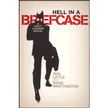
Hell in a Briefcase by Phil Little with Brad Whittington


HAPPY NEW YEAR!!! It is January 1st, time for the FIRST Day Blog Tour! (Join our alliance! Click the button!) The FIRST day of every month we will feature an author and their latest book's FIRST chapter!


This month's feature author is:
Phil Little with Brad Whittington
and their book:
(A Matt Cooper Novel)


Guess what? The publicists for Phil have agreed to a book contest for each FIRST member's blog post on Hell in a Briefcase! It is up to the member on how they judge which commenter wins the free book...so, comment and you might become a winner!

ELEVEN BRIEFCASES AND ONE UNLIKELY HERO...CAN MATT COOPER FIND ELEVEN NUCLEAR DEVICES AND HIS FAITH BEFORE DISASTER STRIKES?

With violence in the Middle East escalating daily, Americans are glued to their televisions wondering what will happen next. Meanwhile, Matt Cooper, jet-setting star of Phil Little's debut novel Hell in a Briefcase is doing something about it. A private security executive, his adrenaline-junkie days consist of last-minute first-class overseas flights, Hollywood parties with his actress girlfriend, and direct calls from top CIA brass.
A chance meeting with Mr. Roberts, “an old broken-down millionaire” and uncommon Christian, sends Cooper on a trip to Israel that will change his life. Matt goes behind the curtain of Middle East terrorism, witnessing firsthand the untold ravages of holy war. The deeper he goes, the closer he gets to a plot involving eleven stolen briefcase nukes and a plan infinitely more sinister than 9/11.

ABOUT THE AUTHOR:

Phil Little, president of West Coast Detectives and a recognized expert in counter-terrorism, provides bodyguards to the stars and runs a detective agency that has served ABC, NBC, CBS, CNN, FOX, Paramount, MGM, and hundreds of others (www.westcoastdetectives.us). He draws on this experience in crafting the tightly wound plot of this international thriller. In addition to his duties as a security expert, Phil has also written Hostile Intent, Protecting Yourself from Terrorism and will soon be the subject of a television pilot. In the meantime, you can read more about Matt's adventures in his blog, http://detectivemattcooper.blogspot.com.

In addition, Phil is available for comment on all aspects of international terrorism, both at home and abroad, and he makes for an interesting and colorful guest. His expertise in the area of international issues combined with his personable on-camera style would make for a great interview on this hot topic. From Lebanese terror camps in the 1970’s to American airports in the months before 9/11, Phil Little has witnessed the terror threat up close and can share eye-opening stories and information that all Americans should know.

THE FIRST CHAPTER:


Marjeyoun, Lebanon.


Thursday, 21 November 2002. 01:30.


A full moon. A glow seemed to rise from the sand, allowing them to drive with their headlights off. The five Jeeps kept to 40 kph on the dark road that wound southward between hills and wadis. In the third Jeep, Major Skaff allowed himself the brief luxury of picking out Pegasus in the sharp winter sky before he compulsively scanned the rocky terrain for signs of Hezbollah fedayeen. He was leading this patrol to check out rumors of increased activity near Shaaba Farms, the disputed area where three Israeli soldiers had been kidnapped two years before.


The ridge road ran from the town of Marjeyoun down to Qlaia’a under the ominous gaze of Shqif Arnoun-the castle called “Beaufort” by the Crusaders-to the west. Christians and Muslims had fought for this ground for centuries, trading possession of the castle as their fortunes rose and fell. In the 1970’s the Palestinian Liberation Organization had used the strategic placement of the castle to shell civilian settlements in northern Israel.


That was when Skaff, then a young recruit of the Southern Lebanese Army, had been a driver in a similar convoy, shortly before the civil war broke out between Christians and Muslims in 1975. Traversing this very ridge on a mission, he had come under fire from the castle. His evasive driving had saved the convoy and drawn the attention of General Lahd.


The intervening thirty years had been a generation of unremitting war. Israel, tiring of mounting civilian casualties and the Lebanese government’s refusal to expel the terrorists, invaded southern Lebanon in 1982 and captured the castle. Eighteen years of occupation followed, during which Skaff had risen through the SLA ranks while working openly with the Israelis to keep the various Muslim factions at bay. When he had started, Hezbollah did not exist. Now the radical Muslim army controlled the south and dealt severely with the Christian resistance.


As the occupation had grown increasingly costly and casualties mounted, the pressure increased for Israel to withdraw. When the SLA collapsed in 2000, Israel destroyed what was left of the castle walls and pulled back behind the Blue Line specified by the UN. The SLA scattered. Thousands fled to Israel or went into hiding. Those who didn’t were imprisoned and tried as enemy collaborators. As Hezbollah gained control of the area, the anticipated slaughter of Christians didn’t materialize. But any SLA militiamen emboldened to return were also imprisoned.


As he scanned the distant ruins of the castle in the moonlight, Major Skaff reflected on change and constancy. Where PLO guns had once rained death on Israel and Lebanese Christians, now tourists snapped pictures and rushed home to post them on the Internet. And the same General Antoine Lahd who had brought him up in the ranks and fought beside him for decades had fled to Paris. Only a week ago he had opened a fancy restaurant in Tel Aviv called Byblos. It had a nice ocean view.


True, Lahd had a death sentence hanging over him for treason and war crimes, but so did Skaff. And so did many of the two thousand SLA in Lebanese prisons.


But some things had not changed. Southern Lebanon was just as dangerous for the men in these Jeeps as it had been when Skaff was driving instead of commanding.


Skaff was drawn from his reflections by a dark shape ahead. At the end of the ridge the road snaked through an outcropping of rock. He had passed through it many times, always with reluctance. This night he felt a peculiar sense of revulsion as he squinted at the misshapen lump of stone looming before him.


He nudged his driver and nodded toward the rocks. Hassan nodded back. He could feel it too. Skaff reached for the radio to signal the lead Jeep. A lifetime of guerrilla fighting had convinced him that such premonitions were not without merit. His transmission was brief, but they were already entering the outcropping when he put the radio down.


Five seconds later a rocket hit the grille of the lead Jeep. The explosion lit the rocks towering over them. He saw the silhouettes of two men blow out on either side of the vehicle, which was tossed onto the nose of the next Jeep. Hassan narrowly missed them, skidding left and stopping next to the driver of the lead Jeep, who was lying half off the road.


The two Jeeps behind slid sideways to a stop in the road as machine gun bursts echoed from beyond the lead Jeep. Skaff was exposed to the attack. He dove from his seat to the rear of the second Jeep, between two men already returning fire with an Uzi and an M-16.


He rolled to his feet and yelled to the two back Jeeps, motioning for them to form a double barricade with their vehicles, keeping the men covered both in the front and the rear in case the attackers attempted to sandwich them in the gap. Skaff turned back, confident that his men needed no further direction. This mission called for battle-hardened veterans, and he had personally selected the nineteen men who were with him now. Every man among them had proved himself in years of combat. Some even owed their life to his cool command in battle. Some had returned the favor multiple times.


Skaff scanned the forward battle to account for the remaining eleven men, his position shielded by the lead Jeep transfixed on the grille of the second. To the left, Hassan was pulling the driver of the first Jeep to safety. The other two men from Skaff’s Jeep were covering him with sporadic fire from their Uzis. Ahead, the driver of the second Jeep was placing a case of grenades handy to his partner, who had fitted his M-16 with a grenade launcher and was set up in the backseat. Skaff was standing beside the other two passengers in the second Jeep. That left the three passengers from the lead Jeep.


He spotted Saif on the right. He had been thrown clear onto the sand without apparent injury. He was crouched behind a boulder, occasionally returning fire with his Desert Eagle .50-caliber side arm. Failing to sight the other two, he shouted to the driver, who had acquired an Uzi.


“Rafik? Sayyed?”


He nodded forward. Skaff crawled over the middle of the jeep to the hood. Sayyed was wedged between the lead Jeep and the grille of the second Jeep, most likely dead. Rafik was lying on the hood of the second Jeep. Skaff checked for a pulse. Nothing. He closed Rafik’s eyes and whispered a short prayer. Skaff couldn’t play favorites with his men, but this loss was harder than any other would have been. At nineteen, Rafik had already spent four years with Skaff, rarely more than fifty yards from his side. Four years of relentless, driven hate. Skaff had been Rafik’s ticket for revenge. Perhaps now he had found the peace revenge had not been able to bring him.


Skaff was crawling back to get a weapon when the second rocket hit the bottom of the lead Jeep. The gas tank exploded, sending most of the shrapnel back toward the attackers. The force of the blast threw the second Jeep back five feet, knocking over the two shooters behind. The grenade launcher and the man with it fell into the front seat. The driver was standing to the side. He returned fire with the Uzi.


Skaff helped reposition the grenade launcher and crawled out of the Jeep. The two in back were already firing again. He scanned the area and then dove toward the two Jeeps in the rear. Of the eight men between the jeeps, one had taken a round in the right shoulder but was still firing left-handed, propped against a door. Three were facing the rear but indicated they hadn’t seen any action, yet. Two were covering the walls on either side with M-16s, but also hadn’t seen action. The final two had grenade launchers on their M-16s. They waited until they saw several volleys of tracer bullets originating from a single location. Then they fired three seconds apart at the source. The machine gun fire stopped. Skaff slapped them on the back. Perhaps they would get out of this thing alive.


Then a rocket hit Skaff’s Jeep. Hassan was behind a curtain of stone, firing with an Uzi, having propped the injured driver in a cleft in the rock. But the other two were using the Jeep for cover. One tumbled backward, clear of the Jeep. The other was knocked down as the Jeep rolled over, pinning his leg under it. Skaff ran through a volley of automatic weapons fire and pulled the first man to his feet. They raced to the Jeep, joined by Hassan, and rocked it back over. Then they dragged the injured man to safety next to the injured driver.


Skaff felt a shudder of unease ripple through the adrenaline-laced focus that always came over him in combat. If this kept up, the whole team would be shredded before they had used half their ammo. He grabbed Hassan’s arm and yelled into his ear over the din.


“We have to take out that rocket launcher or we don’t get out of here. Take those three and circle around.” Hassan nodded and stepped away but Skaff grabbed his arm. “Take a radio.”


He let go, and Hassan ran to the rear while the others laid down covering fire. Skaff used the opportunity to race to the front two Jeeps and get the four there away from the vehicles and behind the cover of the rocks. As they ran for cover, another rocket hit the top of the lead Jeep, sending fragments of the grille and fenders flying in all directions. Skaff ran through the explosion back to the rock curtain. When he fell against a boulder the injured man pointed at Skaff’s leg. He looked down and saw that his left trouser leg was slashed in three places. Blood was seeping down to his boots. He looked around to see how the others had fared.


Saif seemed to have been hit in the arm by something. He was now firing the Eagle while holding his upper arm with the other hand. The other four seemed to have escaped unscathed. Skaff’s radio had not survived the rocket. He nodded to the man next to him, who wielded an Uzi while he made it to the two back Jeeps, getting an Uzi and a radio. He turned it up all the way and slung it over his shoulder. Then he began firing at the source of tracers beyond the rubble of the Jeeps.


Looking for some encouragement, Skaff probed his memory. In almost three decades of fighting, he didn’t recall anything quite as dire as the current circumstance. He had two confirmed dead, one unconscious, three wounded but still firing. Almost a third of the force. The numbers were bound to increase as long as that rocket launcher was working. His calculations were interrupted by Hassan’s voice squawking through the pandemonium.


“We got the rocket launcher, but I think they have another on the left. And now we’re pinned down, so we’re going nowhere.”


The last word was drowned out by a rocket blast on the rock curtain above the injured men. Skaff doubted he could get a team around the other side. Even if he did, the enemy would be expecting them. No way around. No way through. He scanned the sheer rock walls on either side. No way over. The fedayeen had chosen their positions well and appeared to have ample men, weapons, and ammo. It seemed likely that most of this team would share the fate of Rafik and Sayyed. Probably all. The thought sickened Skaff, turning the adrenaline in his veins to bile in his throat.


There was one last hope, but it might be too late. He selected another frequency on the radio and shouted over the gunfire, “Lehafil Levanon Sanctzia. Lehafil Levanon Sanctzia. (Activate Lebanon Sanction.)”


Friday, December 01, 2006

Members Please Read

Hi all. If you are not getting the monthly email I send out for the FIRST post, please email me. Also, check to make sure your blog is listed on the links bookmark for members! Let me know if you are not on it.

Please leave a comment on the Eye of the Oracle post below when you have posted about it on your FIRST post.

Be sure to visit at least one new member this month!

God bless! And MERRY CHRISTMAS!

Eye of the Oracle by Bryan Davis


It is December 1st, time for the FIRST Day Blog Tour! (Join our alliance! Click the button!) The FIRST day of every month we will feature an author and their latest book's FIRST chapter!

This month's feature author is:


BRYAN DAVIS

and his latest book:

Eye of the Oracle


Bryan Davis is the author of the four book Dragons in Our Midst series, a contemporary/fantasy blend for young people. The first book, Raising Dragons, was released in July of 2004. The second book, The Candlestone, followed in October. Circles of Seven debuted in April of 2005, followed in November by Tears of a Dragon.

Bryan is the author of several other works including The Image of a Father (AMG) and Spit and Polish for Husbands (AMG), and four books in the Arch Books series: The Story of Jesus’ Baptism and Temptation, The Day Jesus Died, The Story of the Empty Tomb (over 100,000 sold), and Jacob’s Dream. Bryan lives in Winter Park, Florida with his wife, Susie, and their children. Bryan and Susie have homeschooled their four girls and three boys.

To read more about Bryan and his books, visit the
Dragons in our Midst Website or visit Bryan's blog.

Eye of the Oracle

by Bryan Davis

Dragons in our Midst - Prequel
Oracles of Fire - Volume 1

≈1≈


The Seeds of Eden


Angling into a plunging dive, the dragon blasted a fireball at Lilith and Naamah. The two women dropped to the ground just as the flaming sphere sizzled over their heads. Naamah swatted her hair, whipping away stinging sparks that rained down from the fireball’s tail.


With a flurry of wings and a gust of wind, the dragon swooped low. As razor sharp claws jabbed at the women, Naamah lunged to the side, and Lilith rolled through the grass. A single claw caught Lilith’s long black dress, ripping it as the dragon lifted toward the sky.


Naamah jumped to her feet and helped Lilith up. The dragon made a sharp turn in the air, and, with its jagged-toothed maw stretching open, charged back toward them.


Lilith pushed a trembling hand into the pocket of her dress. “Only one hope left,” she said, panting. Pulling out a handful of black powder, she tossed it over her head. “Give me darkness!” she cried.


The powder spread out into a cloud and surrounded the women. Naamah coughed and spat. The noxious fumes blinded her and coated her throat with an acrid film. A hand grabbed her wrist and jerked her down to her knees just as another flaming cannon ball passed over their heads.


“Crawl!” Lilith ordered.


Naamah scooted alongside Lilith as she scuffled over the dry tufts of grass. Sparks from the rain of fire ignited tiny blazes that illuminated their hands as they passed through the veil of darkness.


Naamah gagged but refused to cough. With a guardian dragon hovering somewhere overhead, giving any clue to their whereabouts could be fatal.


After several minutes, Lilith whispered, “I think I found the cave.”


Her hands, barely visible and clutching a small bundle of sticks, crawled over a bed of gravel and then to a rocky floor. When she finally stopped, Naamah sat up and gazed into the dark cloud behind her. She squeezed fractured words through her tingling throat. “Will the dragon follow?”


“Shachar is persistent,” Lilith rasped, “but she is no fool.” She coughed quietly, clearing her voice. “She will not risk the possibility that we’re a diversion for a more dangerous attack. If she doesn’t find us soon, she will go back on patrol.”


“What about her dragon sense? Won’t that draw her to us?”


“I’m not sure. A dragon’s danger alarm is still a mystery to me. I think since our only direct threat is to the ancient garden she patrols, her sense of protection will draw her there.”


The black cloud began to dissipate, revealing the mouth of a shallow cave, barely deep enough to keep out the wind. Close to the back wall, the women found a flat stone and built a fire next to it with Lilith’s collection of sticks. When the crackling flames began to rise, Lilith and Naamah sat on the stone to rest.


From her pocket, Lilith withdrew a small bundle wrapped in a black cloth. After untying a knot on one end, she produced an earthenware cup filled with herbs. “The way to Eden has yet another obstacle,” she said, tossing a pinch of the herbs into the campfire. “Our task will not be easy.”


Sparks flew toward the cave’s low ceiling, riding on thin strings of silvery-green smoke. Naamah breathed deeply of the aroma-saturated air, a pungent blend of camphor and garlic. She exhaled, tasting the herbs at the back of her tongue. “What could be more difficult than getting past a dragon?”


“There are forces in our world that dwarf the power of dragons. I have foreseen much that you don’t know.”


As cool, damp air chiseled away at the fire’s rising warmth, Naamah scooted toward her sister, overlapping the fringes of their silky black dresses on the flat stone. Barefoot and shivering in the draft, she wrapped her arms around herself. “Didn’t you know it would be this cold? We should have worn our cloaks.”


“It is only temporary. The cold air is a path that leads us to the garden.” Lilith pushed her long black hair off her shoulder and huddled close, her voice low. “Naamah, you must have more faith in me. My husband’s arts have allowed me to see another world, the world of phantasmal knowledge. It is the realm of future possibilities, where I can see what might happen.”


Naamah folded her hands. “What might happen?”


The bushes rustled just outside the entrance. Lilith glanced over her shoulder, her lips pressing into two pale lines as she set the cup of herbs on the cave’s floor and drew a dagger from a sheath on her belt.


“Just the wind,” Naamah whispered. “If it were the dragon, we would have heard her wings.”


“Perhaps.” Lilith’s knuckles whitened as she wrung the dagger’s wooden hilt. “But even the wind carries spirits who might expose our plans.”


Naamah waited for the color to return to Lilith’s fingers. “So … why are you counting on phantasmal knowledge when it can’t tell you for sure what’s going to happen?”


“Because our opponent is so predictable.” Lilith placed her long, thin hand on Naamah’s thigh. “Life is the ultimate game of chance, with millions of possible moves, so I only see what might happen. My choices and our opponent’s choices mesh in a tapestry through time, and I can see where some of the threads lead if I follow one or more of the thousands of patterns that fill my eyes. So far, Elohim has reacted to my moves exactly as I expected he would.”


Lilith waved the dagger over the fire. A bright, angelic creature swirled inside the rising smoke, its image warping and undulating as the draft swept it around. Inside the flames, a red dragon appeared, jets of fire blasting from its nostrils. The dragon’s blaze licked at the angel’s bare feet as it whipped around in the smoke’s endless circles. “Our plans rest on Samyaza’s shoulders, and if he fails, our doom is certain. We must prepare for that possibility.”


Naamah rubbed her hands up and down her bare arms. “How can this husband of yours give you the power to see the future? I have never known a man who could see past a bottle … or a brothel.”


“You have never known such a man, because you don’t know the Watchers.” She thrust the dagger back to its sheath. “Your men are all fools.”


Naamah pulled the hem of her dress high above her knee. “Fools, yes, but their money spends as well as yours.”


Lilith slapped Naamah’s hand and yanked the skirt back down. “Your harlotry will be the death of you someday! Sister or not, I cannot protect you from yourself.”


Naamah caressed her stinging hand and scowled. “You didn’t call it harlotry back when we were collecting wild oats together. You’ve been no fun at all since you got religion with Samyaza.”


Lilith grabbed Naamah’s shoulder and pulled her almost nose to nose, hissing. “This religion, as you call it, might just save your life. If you want to survive, you had better listen to me!”


Naamah jerked away and scooted to the far edge of the stone. “I’ll listen. Just don’t turn me into something unearthly, like that iridescent dog you keep in your dungeon.”


“That was from one of my first potions, and you know it.” Lilith sighed and reached for Naamah’s arm. “If Samyaza wins, then we won’t have to turn into anything unearthly. If he loses … well, he need not know our alternate plans.”


“Is that why you’re so jumpy? Do you think your husband’s spying on you?”


“I do feel the presence of a spy, but I doubt that Samyaza sent it.”


“So what should we do?” Naamah asked.


“This spy is of no consequence. Shachar is the greater danger, but she will leave the area soon enough, and we will press on. Until then, we have time for an important step in my plan.” Lilith lifted a thin cord around her neck and pulled a leather pouch from her bosom. She loosened the drawstring and carefully poured into her palm a dozen or more white crystals the size of cottonseeds, covered with tiny spikes that made each crystal resemble the head of a mace. “These are the seeds of Samyaza’s power. With them we will be able to plant his potency wherever we please.”


Naamah touched one with her fingertip and rocked it back and forth. “We will?” she asked.


Lilith poured the seeds back into the pouch but kept one in her palm and closed her fingers around it. “Our master will teach you how to use it soon enough, but first we must prepare ourselves as vessels—myself to wield the power and you to receive the planting.” She picked up her cup, dropped the seed inside, and stirred the contents with a slender black root, holding the cup just above the flames as the herbs melted into a thick brew. After seven swirls, she crumpled the stirrer and threw it into the mix. As purple foam rose above the brim and dribbled over the sides, she waved her hand over the top and sang in a low, mournful voice.


O Master of the midnight skies,
The god of darkness, light disguised,
Provide for me the gift of flight
And give me wings to flee my plight.


Now through the waters guide my strife,
And grant the gift of lasting life.
Regenerate my body whole;
For this I give my living soul.


And should my husband learn my plans,
O let his reins come to my hands,
For strength alone cannot compare
To woman’s last beguiling snare.


O let us be the farmers’ hands
To sow the seeds of fallen man.
The giants planted here must grow
Escaping from these lands below.


In Naamah’s womb prepare your soil.
With calloused hands we’ll sweat and toil.
O make your seeds become like trees;
To trample Adam’s hopeless pleas.


With both hands trembling, Lilith raised the cup to her mouth and took a long, slow drink. She closed her eyes and grimaced, a shudder crawling across her pale cheeks. After licking her lips, she rubbed some of the liquid into each of her palms, then extended the cup to Naamah.


“You must be joking!” Naamah said, squinting at the curling purple fumes. “I’m not drinking that!”


Lilith took Naamah’s hand and wrapped her fingers around the handle. “Just smell it! That’s all I ask. Then decide if you want to drink or not.”


Naamah tightened her grip on the handle and gazed into the cup. Thick gray liquid bubbled inside. Warm vapors and a pleasant aroma bathed her senses. As she took in the delightful smell, her throat dried out, filling her with a sudden desire to drink. Her tongue clamped to the roof of her mouth, parched and swelling. It was more than a desire. She had to drink. Now!


She guzzled the liquid, then slung the cup against the cave wall and glared at Lilith. “You tricked me!”


Lilith wagged her finger. “It was for your own good.”


Naamah crossed her arms over her chest and stared at the earthen shards. “I am going to turn into something disgusting, aren’t I?”


“The potion does much more than that. Even if our earthly bodies die, we will be able to exist in another form. As our new bodies age, we will be able to use Samyaza’s power to regenerate ourselves. But if we can get on the boat, we won’t have to worry about unsavory transformations at all.”


Naamah swung her head back toward Lilith and rose to her feet. “On the boat, you say?”


“Yes. The most obvious phantasmal thread leads to a terrible flood. Our enemy is building a boat that we could use to save ourselves, but the builders have a strange shield around it. Although normal humans can penetrate it, the Watchers and Nephilim haven’t been able to. They want to destroy it and change Elohim’s plan to flood the world. I, however, wish to find a way to get us on board in case they fail.”


Naamah paced slowly in front of her sister. “I know a man who is working on a boat. He said it is very large and well-supplied.”


“That would be the one,” Lilith replied. “But the builders are unlikely to give away the secret of the shield.”


“When he is at the market, he speaks only of supplying the boat.” Naamah stopped, cocked her head upward, and smiled. “But when he visits my room, his lips become quite loose.”


Lilith scowled. “Loose being the operative word.” She stood and slipped her hand around Naamah’s elbow. “Did this man mention the shield?”


Naamah swiveled her hips, twirling her dress slowly back and forth. “No, but if you let me sing a song to him, I can charm him into spilling his secrets.”


“Oh, really?” Lilith tipped her head upward and stroked her chin. “What’s his name?”


“Ham.” A burning pain drilled into Naamah’s pelvis. She laid a hand over her stomach but tried not to show how much it hurt. “I don’t know his family name.”


“I wish you had told me about this before,” Lilith said, tapping her foot on the ground. “We have to find this man.”


The pain stabbed Naamah again, but deeper than before, as if something had grasped her womb with sharpened claws. Still, she forced herself to keep a calm face. “If you’d let me in on your secrets once in a while, maybe I would have known you were trying to get on board.”


Lilith glanced out at the bushes again and slowly turned back. “Very well. I will tell you why we are on this journey. You will soon see how all my plans tie together.” She picked up a long stick and stirred the coals in their fire, creating a billowing gray plume. A new vision coalesced in the smoke, an angel standing next to a tree. The fire spewed a finger of flame through the angel’s hand, making him appear to have a brilliant sword that flashed as he stood guard.


“That is the tree of life, and I have long coveted its fruit.” Lilith pointed at the flame. “Here is our problem. One of the Cherubim protects it with a sword that creates a shield of light.”


“I see,” Naamah said. “Now that you have one of the Seraphim on your side …”


“You’re way ahead of me.” Lilith glanced outside and checked the brightening morning sky. “Samyaza will be there soon. I want to see him battle the Cherub and win the sword, then we can pluck the fruit at our leisure. Once he has regained his weapon, he will be invincible, perhaps even against the archangels.”


Lilith arose and, bending low, sneaked out of the cave. Naamah followed close behind, pressing her hand against her belly again. Whatever that potion was, it seemed to be turning her organs inside out.


Constantly glancing at the sky, they wound their way through a dense forest, padding softly on a wide clover path until it opened into a field. Lilith halted suddenly and stooped next to a leafy bush. Naamah leaned over her, trying to follow her sister’s line of sight. In the distance, a white glow arose above a thick, thorny hedge that extended as far as the eye could see.


Lilith’s voice softened to a low hiss. “The hedge is Eden’s boundary. The thorns are sharper than any sword, and the poison in the tips will shrivel you into a prune in seconds. The only way to enter is through the guarded gate.” She skulked to the hedge and followed it toward the glow, Naamah once again trailing her. As they drew closer, a gap appeared in the hedge, and the guarded tree came into view. Stooping again, Lilith pointed at a beautiful, white-robed angel. “His sword shoots out a beam of light that can kill us even this far away. As long as he waves it over his head, it creates an almost impenetrable shield around himself and the tree.”


Naamah settled quietly behind her and peered at the darkening sky. Black clouds boiled overhead. Bolts of lightning streaked jagged forks across the heavens. “Something weird is happening,” she whispered.


“I didn’t expect this.” Lilith’s brow bent downward. “Samyaza planned to come by stealth, not with a lightning fanfare.”


Naamah pointed toward the top of a tall sycamore tree. “I see him.”


A winged angel, bright and shining against the stormy backdrop, glided to the ground, his silver hair flowing in the freshening breeze. Dressed in white robes, drawn tight at his waist by a golden sash, he strode to the gate and spoke to the other angel in a booming voice. “Greetings in the name of Elohim.”


The Cherub nodded, waving the sword to keep the shield in place. “May our God be glorified forever. What brings a Seraph to Eden’s boundary today?”


“I have come to relieve you of your duty. You are to return to the council for a new assignment.”


The Cherub glanced up at the troubled sky. “Something is amiss. I sense God’s hand moving in the heavens, yet no messenger has alerted me of a change.”


“I am the messenger.” Samyaza held out his hand. “Give me the sword and go your way.”


The Cherub lowered the sword, and the shield blinked off, but he kept the hilt firmly in his grip. “With all due respect, my liege, what is your name?”


“I am Samyaza, prince of the guardian angels.” He took a step closer, bringing him within arm’s reach of the Cherub. “It would not be wise to continue questioning my authority. Remember Lucifer’s folly.”


The sword trembled in the Cherub’s hand, but his voice remained steady. “Your name is familiar to me, and you have the wings of a Seraph, but I am here by order of the Majesty on High, so I cannot abandon my post on your word alone. Only Michael can countermand the order.”


Streaks of darkness shot out from Samyaza’s eyes, splashing the Cherub with a sizzling, oily resin that stuck fast to his robes and spread quickly over his hands and face. The sword’s light flashed on in the blinded angel’s hands, sending a bright beam blazing into the sky. Samyaza lunged forward and shook the Cherub’s wrist, slinging the blade under the branches.


Pushing the angel to the side, Samyaza flew toward the trunk, snatched up the sword, and stalked toward the gate. The Cherub threw himself toward the sound of Samyaza’s pounding footsteps and wrapped his arms around his neck. The powerful Seraph reached back, grabbed the Cherub’s hair, and heaved him toward the tree. The resin-covered angel slammed against the trunk, knocking white fruit to the ground. Samyaza marched toward him, his sword raised.


A loud clap of thunder shook the earth. Another angel, the largest yet, burst from the clouds and zoomed to the ground, landing with a drawn sword raised to strike. “Be gone, Samyaza, you wretched liar. You will not have this tree or its fruit.”


Samyaza backed away, visibly trembling. “Michael! I have no quarrel with you. This was my sword before I—”


“Before you left our Lord and Master to satisfy your carnal desires.” Michael helped the Cherub to his feet, and with a wave of his hand, the black resin melted away. “Take the sword and crawl back into your hole with your corrupted followers. It will be nothing more than a carving knife to you now.”


Samyaza held the sword aloft, but it created no beam. Not even the tiniest spark flashed from the blade. He thrust the tip into a patch of clover and drove the sword into the ground up to the hilt, then shook his fist at Michael. “The people will follow us, not the tyrant in heaven! They want to be free of his authority, and we will teach them to follow the longings of their hearts!”


Michael waved his sword and a new, brighter shield covered the tree. As the dome swirled with radiance, the entire plot of ground ripped away from the earth, uprooting the tree and carrying Michael, the Cherub, and the fallen fruit with it. “If people want true life and freedom,” Michael said as they slowly lifted into the sky, “they will look above. Like rain from the heavens, that is the source of their deliverance.”


Boiling clouds swallowed the shimmering tree, and, for a moment, all was quiet. Samyaza stared at the ominous ceiling, slowly turning and backing away from the garden. His wings beat the air, and, just as his feet lifted off the ground, a dragon burst out of the clouds shooting twin jets of fire from its nostrils.


Black streams surged from Samyaza’s eyes, colliding with the fire. The impact created a sizzling eruption of smoky gas that spewed high into the air. The dragon pulled out of its dive and zoomed by Samyaza, smacking him with its tail before ascending again toward the clouds. Samyaza toppled, but a flurry of his wings kept him from striking the ground.


Lilith leaned over and whispered to Naamah. “Samyaza likely remembers how his master conquered the first female human. It will be interesting to see how he deals with the first female dragon.”


Samyaza yanked the sword out of the ground and stabbed it at the sky. “Does the mate of Arramos only fight when she can attack by surprise?” He turned in a slow circle, his eyes darting in all directions. “Come and meet me in single combat, if you dare!”


Shachar burst out of the clouds again, and with a great beating of her wings, she landed in front of Samyaza. “I am not a dog to be baited by a bone,” she roared.


The Seraph spread out his arms. “Yet, you are here, panting and drooling for the very bone you disdain.”


“Only to lance a demonic abscess.” She pawed the ground with her claws. “If you desire a fair fight, drop the sword and let us see who wields the greater power.”


“As you wish.” Samyaza bowed dramatically and released the sword.


“Step away from it,” Shachar ordered. “Far away.”


Samyaza marched several paces to one side and gestured toward the sword. “Satisfied?”


Shachar nodded her scaly head. “Trusting you is a fool’s game, but I will risk what I must to rid the world of its greatest plague.”


The shining angel flashed a wicked smile. “Since you are the aggressor, I invite your first volley.”


Shachar lunged at him, her teeth bared and her nostrils flaming. Samyaza dipped under her jets and latched on to her tail as she passed over. With a mighty spin, he slung her in the direction of the sword. The dragon crashed to the ground and slid next to the hilt. As she lifted her wobbly head, her eyes seemed glazed and distant.


Samyaza zoomed to her side and grabbed the sword. With a dramatic thrust, he plunged the blade into the dragon’s underbelly. Shachar let out an ear-piercing shriek and writhed in the grass. “Coward!” she screamed. “Deceiver!” She spat out a weak ball of fire, but it rolled past the towering Seraph as he backed away.


When the dragon’s throes settled down, Samyaza grasped the hilt of the sword and withdrew it from her body, jumping away from a gush of fluids. He glared at the bloody blade and dropped it to the ground. “Disgusting creatures!” With a flap of his wings, he lifted into the air and disappeared in the blanket of clouds.


Shachar opened her mouth as if trying to speak. She twitched for a moment, then heaved a final sigh as her eyes slowly closed.


Lilith and Naamah ran toward the dragon. Lilith snatched up the sword and wiped the blade on the grass. “Samyaza might not be able to use this,” she said, turning the blade over to clean the other side, “but if I can find the secret behind its flame, it could be a powerful weapon indeed.”


She propped the blade over her shoulder and strode through the gateway, now unattended by angel or dragon. Naamah followed, gazing at the devastated garden. Knotted trees with bent crowns and twisted branches plagued the endless fields of dry grass. On one squared-off plot, leggy bushes hunkered over a tangled mess of tall weeds and thorny vines. Hundreds of thistles raised bristly heads among row after row of dwarfed fruit trees and shriveled vegetables. Naamah let out a low whistle. This was no Paradise, no land of perfection, despite the claims of her childhood songs.


Lilith tramped down to the bottom of the hole where the tree once stood. She stooped, pinching a sample of soil and drawing it close to her eyes. “Not a trace. Not a root or seed anywhere.”


Naamah noticed a glinting speck in the dirt. “Here’s something!” She plucked out a smooth white pebble, barely as large as her fingertip, and handed it to Lilith. “Could this be a seed?” she asked. “It looks like a pearl.”


“It could be.” Lilith knelt where Naamah found the pebble and used her finger to stir the soil, a mixture of moist brown dirt and a strange white paste. “Here are two more.” She collected them and slid all three into her pocket. “We’ll keep them for posterity.”


“Posterity?”


“Future generations. I don’t know how long it takes to grow a tree of life, but I intend to find out.”


Lilith gazed toward a path that led into a stand of skinny oaks. “The other tree should be in that direction,” she said, pointing.


As she headed toward the wood, she swiped Samyaza’s sword in front of her as if fending off an invisible enemy or perhaps testing its weight and balance. Naamah had to jog to keep pace with her sister. Lilith’s stern expression told her it wasn’t a good time to ask questions, so she just stayed at her side, taking in the sights of loss and waste in the massive garden.


After following the path through the trees, they arrived at a glade. In the center of a circle of grass, a tree, heavy with red, oblong fruit, stood tall and lush. Lilith strode right up to the nearest branch and called out, “Lucifer, my lord and master, I bring you vital information.”


A fresh breeze flapped Lilith’s dress as she stood in stoic silence, the tip of the sword touching the ground in front of her. The wind crawled up Naamah’s legs, bringing her a chill. The pain in her stomach had settled, but a new queasiness took over. Something foul drew near, worse than a fetid carcass. Whatever it was seemed to seep through her skin and into her heart, making it slow to a few, sickening thumps.


Soon, a gentle hissing joined the shush of the wind. A long, thick snake slithered out onto the branch and rested its head near a bobbing fruit. Lilith extended her arm and pushed her hand under the serpent’s belly. Bearing scales like sun-baked leather, black hexagons meshed with olive-green, the snake crept along Lilith’s pale arm. Its tongue darted in and out from its triangular head as it spoke in a slow, threatening cadence. “If you have come to tell me about Naamah’s customer, you have come in vain. While I am in this cursed condition, my disciples sneak in through the garden’s western gate. One of my agents overheard your conversation and reported the news about this boat builder.”


“So that’s what we heard in the bushes,” Lilith said. “It was a spy.”


The snake flicked its tongue, touching her cheek with its forked points. “I send spies on my enemies and my followers, especially followers as ambitious as you.”


As the snake wrapped a coil around Lilith’s neck, she lifted her chin and swallowed hard. “And how shall we use the information, my lord?”


The snake maneuvered its head in front of Lilith’s eyes, wavering back and forth in a hypnotic sway. “I sent my agent to speak to my servant, Lamech, son of Mathushael. I have ordered Lamech to adopt Naamah into his family. Naamah’s new brother, Tubalcain, knows Ham and will offer her to be Ham’s wife.”


“His wife?” Naamah said, crossing her arms over her chest. “Ham is a regular customer, but that doesn’t mean I want him for a husband!”


The serpent’s head shot toward Naamah, its fangs extended as it bit the empty air just inches in front of her eyes. Naamah staggered backwards, catching one of the tree’s branches to keep her balance. Recoiling over Lilith’s shoulders, the serpent hissed, “Either marry him or die!”


Naamah shivered in the tree’s shadow, holding her stomach again as the fierce pain stabbed her insides.


The serpent turned its flaming red eyes back to Lilith. “Ham’s father will recognize your name, so you must change it before you meet him. We cannot allow him to know who and what you are.”


“Of course, my lord.” Lilith kept her head tited upward. “Do you have a preference?”


“Choose whatever pleases you. I will arrange things to make your new name work.”


Lilith smiled. “As you wish, my master.”


The serpent’s tongue flicked again. “I have news about the sword.”


Lilith lifted the blade. “The secret to its flames?”


“Yes. The sword is designed to detect the nature of the hands that grasp it. The flames shoot from the blade only if the hands are innocent and undefiled. Of course, the Cherub who guarded the tree of life was holy, so he was able to use the blade’s protective shield over the tree.”


Lilith ran a finger along the blade. “And Samyaza’s hands have been deemed corrupt.” She gazed at the grip, wiggling her fingers around it. “Can the sword be fooled into thinking it is being held by holy hands?”


“Perhaps. It has no thinking process of its own. It merely responds to how it was forged.”


Lilith studied the etchings in the blade’s silvery metal. “Who are the two dragons doing battle in the design?”


“I am one of them, and I struggle with a dragon who is to come, a warrior who will fight with me to become king of the dragons. Michael etched that symbol when he gave the sword to Samyaza and commissioned him to find and protect the holy dragon who would come to try to conquer me.”


“I see,” Lilith said, nodding. “So this king must have holy hands in order to defeat you.”


“Yes. But since this usurper could be a human representative for the dragons, our goal is to corrupt every family line, whether dragon or human, with the seed of the fallen ones. But, beware. Elohim has already hatched a plan to thwart ours. I know little more than a code phrase one of my disciples overheard—‘oracles of fire.’”


“That’s it? No context?”


“Only that there are two of them. Perhaps a pair of angels commissioned specifically to infiltrate our ranks and destroy our work from within.”


“I will watch for them.” Lilith lowered the sword. “And when will you become a dragon again and leave the garden?”


As the serpent slithered along Lilith’s arm, she raised her hand to the tree. It coiled around the branch, and its head turned back toward her, its voice echoing like a ghostly whisper. “When I steal the body of a certain dragon, I will be whole once more.” It crawled back into the thicker foliage and disappeared.


Naamah ran from the tree and sidled up to Lilith, crossing her arms again. Lilith chuckled and kissed the top of her head. “Don’t worry, Sister. Yours will be a marriage of convenience. We can dispose of Ham when he has served his purpose.”


Naamah turned her back to Lilith, her arms still crossed. “Then you marry him. You seem ready to betray your husband.”


Lilith grabbed Naamah’s shoulder and spun her back around, her eyes turning bright scarlet. “I’m doing this for us!”


The pain from Lilith’s grip made Naamah shake. As she stared at her sister’s fiery eyes, she felt tears forming in her own.


Lilith slowly relaxed her fingers. Stroking Naamah’s hair, she leaned close and whispered, “Lucifer has given me the means to carry out the plan that will save our lives. He knows Samyaza is not likely to cooperate, but I don’t really want to betray my own husband.” She pressed the tip of the sword into the grass. “I won’t resort to draining his power unless I have to.”


“Draining his power?” Naamah pointed at the sword. “With that?”


“No.” Lilith spread out her fingers, showing Naamah her palm. Splotches of purple stained her skin from the heel of her hand to her fingertips. “My seed concoction has many uses, and absorbing potency will come in handy.” Reaching up, she caressed one of the red fruits dangling from the tree. “Speaking of seeds” —she plucked the fruit—“I think these might also come in handy.”


“For posterity again?”


“In a manner of speaking, yes.” Lilith dropped the apple-sized fruit on the ground and chopped down with the sword, slicing it cleanly in half. Kneeling, she picked through the flesh, collecting six seeds, then, spreading out her fingers again, she let the sparkling red seeds roll around on her stained palm.


“They look like rubies!” Naamah said.


Lilith dropped them into her pocket along with the others. “Much more valuable than rubies, Sister. They are the seeds of corruption. And those who control the corrupting influence wield the power to rule the corrupted.”

Reading level: Young Adult
Paperback: 609 pages
Publisher: AMG Publishers (September 25, 2006)
Language: English
ISBN: 0899578705